Group 8

Understanding Osteoporosis: A Comprehensive Resource
What is Osteoporosis?
Osteoporosis is a common chronic disease that primarily affects skeletal bones. It is characterized by weak, brittle bones that have increased susceptibility to fracture. With osteoporosis, the body breaks down old bone faster than it can replace it, leading to low bone mass and deterioration of bone tissue. The outer shell of the cortical bone itself becomes thinner, and the walls of the honeycomb-like trabecular bone structure becomes thinner with larger spaces between them.
1
Symptoms of Osteoporosis
Clinically, osteoporosis is often asymptomatic until a bone breaks, most commonly the hip, wrist, or spine.
Common Symptoms:
-
Fractures - from a minor fall or bump are often the first indication
-
Loss of height overtime
-
Changes in posture - stooped or hunched as the spine's vertebrae become compressed
-
Back pain - caused by fracture of collapsed vertebra
Less Common Symptoms:
-
Receding gums - due to bone loss in jaw
-
Weak or brittle fingernails - sign of hormonal changes or nutritional deficiencies
-
Decreased grip strength - indicator of lower bone density
2
3
Etiology of Osteoporosis
Osteoporosis is related to the process of aging in combination with decreasing sex hormones, for women decreased estrogen and for men decreased testosterone. Bone microarchitecture deterioration leads to loss of bone mineral density. medications such as glucocorticoids, anti-epilectics, chemotherapy agents, proton pump inhibitors, and thiazolidines can contribute to secondary osteoporosis. Osteoporosis can also be the result of other disease processes, such as hyperparathyroidism, anorexia, malabsorption, hyperthyroidism, chronic renal failure, and Cushing's syndrome.
Risk Factors:
-
Increasing age
-
Low body weight
-
Women > Men
-
Smoking
-
Family history
-
White or Asian race
-
Early menopause
-
Low levels of physical activity
-
Poor diet
-
Excessive alcohol intake
4
4
Pathogenesis
The biological mechanism for this disease include three fundamental mechanisms:
1
Failure to achieve a skeleton of optimal strength during growth and development
2
Excessive bone resorption resulting in loss of bone mass and disruption of architecture
3
Failure to replace lost bone due to defects in bone formation
5
5
5
Bone Formation Mechanism
Reabsorption, the daily removal of small amounts of bone mineral, is balanced by the equal deposition of new minerals. These concurrent processes work to maintain bone strength. If this balance leans towards the excessive resorption, then bones will become weak over time, eventually becoming brittle and prone to fracture. The balance between resorption and deposition is determined by the activities of two important cells:
5
6
Osteoclasts
These cells have highly active ion channels on their cell membranes which pump protons (H+) into the extracellular space.
This lowers the pH in their own microenvironment, ultimately leading to the dissolving of bone mineral.
They also provide proteolytic enzymes (Cathepsin K) which dissolve the bone matrix.
Osteoblasts
These cells are responsible for building new bone. They produce and secrete collagen and other proteins that form the bone matrix, known as osteoid.
Once this matrix is laid down, osteoblasts help mineralize it by depositing calcium and phosphate, which hardens the bone.
Some osteoblasts become trapped within the matrix and mature into osteocytes, where they help to maintain bone tissue and regulate remodelling over time.
5
7
5, 7
8
9
9
An overview on bone formation and remodelling:
Osteoclast Activation Phase
Usually initiated by an interaction of hematopoietic precursors with cells of the osteoblast lineage.
It can also be initiated by inflammatory cells (T cells).
Limited Resorption and Reversal Phases
Upon the formation of the osteoclasts, there is a limited resoprtion phase and a brief reversal phase where the bone surface is covered in mononuclear cells.
Formation Phase
This begins with either:
1. Factors produced by the osteoclast
2. Reversal cells
3. Released by bone matrix
Production of the matrix via progressive osteoblast waves occur
6
6
6
6
The formation phase is longer than the previous three phases, thus any increase in remodelling activity tends to result in a net loss of bone.
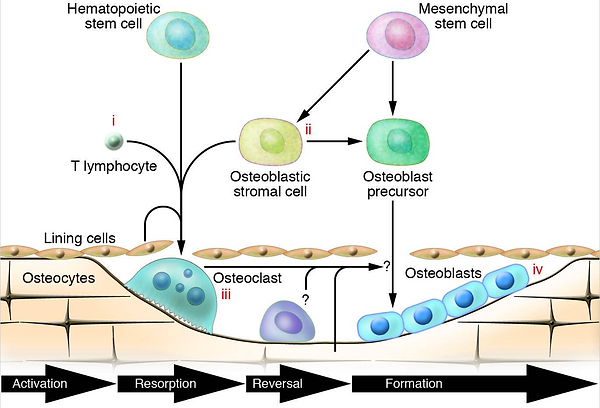
DOI: 10.1172/JCI27071
The Role of Estrogen
Estrogen is a key regulator of bone remodelling, helping to maintain the balance between bone formation and resorption. A decline in estrogen disrupts this balance, leading to increased bone loss and a higher risk of fracture.
6
Calcium and Vitamin D Role
Calcium and Vitamin D are essential for keeping bones strong. When levels are low, the body pulls calcium from bones to maintain normal blood levels, which weakens bone over time. Vitamin D deficiency also reduced calcium absorption and increases hormone signals that speed up bone breakdown. Together, this leads to increased bone loss, higher fracture risk, and even muscle weakness that can increase the chance of falls.
6
Remodelling Imbalance and Impaired Bone Formation
A core feature of osteoporosis is the inadequate osteoblast response to increased bone remodelling, which contributes to net bone loss even when bone turnover is high.
This occurs due to age related decline in osteoblast replication and differentiation as well as defects in local and systemic growth factor signalling.
6
6
Key Growth Factors Involved:
Bone Morphogenetic Proteins (BMP)
Insulin-like Growth Factor 1
(IGF-1)
Transforming Growth Factor (TGF-β)
How they are involved:
Genetic Polymorphisms
BMP2 polymorphisms are strongly associated with low BMD and fracture risk.
IGF-1 and TGF-β polymorphisms are also linked to fracture risk.
Leukotrienes
Leukotrienes promote resorption and inhibit formation.
Specifically ALOX15 has been identified as a negative regulator of bone density
Glucocorticoid-incuded
Inhibition of local IGF-1 leads to the reduction of bone formation.
Nitric Oxide (NO)
NO is produced by bone cells and is required for anabolic response to mechanical loading.
NO may inhibit bone resorption via increased OPG.
NO donors are associated with increased BMP.
Cytokines and Bone Loss
Pro-inflammatory cytokines such as IL-1, IL-6 and TNF-α can increase osteoclast activity and disrupt the coupling between resorption and formation.
Specifically for humans, cytokine gene polymorphisms influence bone mass.
Collagen Quality
Type 1 gene polymorphisms are linked to fracture risk independent of BMD.
14
13
6
6
6
17
6
18
16
15